The poetic, playful and prophetic musings of quintessential voices trying to keep up with life

Wednesday, May 22, 2013

Weight/Story: Rebuilding a Broken Relationship


This post is geared primarily at women, who have likely been sent similar messages about their bodies as I have. I fully acknowledge that men also have absurd body standards, but as I have no experience being a man, this post is directed at women. While writing this post I felt myself touching the edges of race and class, knowing that beauty standards differ across social groups, and so I feel that it's important to also note that my experience is that of a white, middle class woman, and many of my encounters in life are a reflection of those identities. I believe the way we've been socialized and the experiences we've had greatly impact us, and the issue below is absolutely representative of that.

There is a weight problem in this country and I'm not talking about obesity. It's everywhere I go, in every show and movie I watch. It's taunting me, talking behind my back, and toying with my emotions every chance it gets. The obsession with a single woman's body type, a certain, specific, often unattainable body type, is running rampant everywhere I look and it has got to stop.

My body and I have had a broken relationship for an entire decade. Let me be clear, I've never been very overweight. The battle has been mainly internal, but at times it has been absolutely all consuming.

Sometimes this problem manifests itself in intense loathing, other times it's a subtle choice to avoid and ignore my own body and its needs. As I have eluded to in the past, I spent a chunk of time in high school starving myself, attempting to become someone I'm not, struggling to fit myself into a tiny box that no one should ever be trapped in.

When I gave up this harmful behavior, I went to the other extreme. I stopped looking at myself in the mirror and began eating food without thought, scared I would once again fall into the trap of being consumed by the amount or kind of food I was putting into my body. I refused to listen to my body tell me it was hungry, tell me it was full, or even tell me when it enjoyed the food I was eating.

It felt like a trade off. Either I cared about my body and what I ate, became obsessed with controlling my diet and exercise, or I had to ignore my body completely. For awhile, I chose the latter, believing that avoiding part of myself would allow me to regain the things I lost during my stint with anorexia - a social life and the ability to focus on something besides food, exercise, and my weight.

Mark Parisi Cartoon
I lived that way for many years, graduating from both high school and college with this attitude. Finally, my perspective began to change right after college when I lived with three women who loved food for how it tasted, for what it did for their bodies, and for the energy it gave them. Slowly my mindset changed and I began seeing food differently. At some point in this journey, I began enjoying food again. I learned how to cook food I like to eat. I learned how to eat food that would make my body feel better. I learned that food is a tool that my body uses to help maintain an active lifestyle.

After 10 years of battling my own body, I can finally say I (mostly) like my body. I like how it looks, I like what it does for me, I like living in it. I've (again, mostly) stopped caring that my body isn't the ideal image of beauty. I've started putting health before the attempt to conform to someone else's standards.

But this isn't exactly a happy ending.

Call it a first world problem (and if you've missed out on this ironic way of talking about problems, just click on the link and get with the times!!), but I've found it oddly unsatisfying to be happy with my body. After a decade frustration, I now find myself wondering what all the fuss was about. Why in the world did I spend my entire teenage life and my early twenties consumed with this superficial quest?
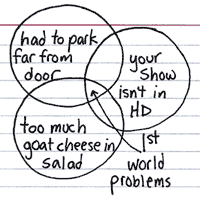
knowyourmeme.com
In fact, I would absolutely call this weight obsession a first world problem. First world, as in it disproportionately impacts people who have time and energy (and often money) to put into attaining (or attempting to attain) a particular figure. People who have easy access to the media and feel pressured to look like the people they see in it. I know with absolute confidence that I'm not alone in my tendency to be consumed by body image issues. This problem has spread throughout first world countries (and beyond), sucking our time, our energy, and our happiness.

Let me be clear that I truly believe that taking care of our bodies is essential for living a good life. But where we go wrong is when we mistake slender figures as a sign of health. While being thin can absolutely be healthy for some, others must starve themselves (which is awfully unhealthy) to achieve these same standards.

We've forgotten that our bodies are all different. We've forgotten that diversity is a beautiful thing, that everyone looking the same, weighing the same, would be boring as hell.

And, as a result, we end up trying to attain this one precise figure, one that for a lot of people just isn't sustainable, life giving, or even fulfilling.

This attitude is absolutely everywhere I turn. Have you ever listened to people after they finish a big meal? What words come out of their mouths? "I shouldn't have eaten all that food." "Well, I'm going to have to go work that off." "Why did you make me eat all of that?" Or the even more unhealthy language, "I'm going to have to skip dinner for a week now."

We've been taught that our bodies don't look like they should and it leaves us feeling constantly guilty for enjoying food. Rather than focusing on how our bodies can be healthy so they work efficiently and effectively, we are overwhelmed with media images of the same thin figure over and over and over. We hear a constant chatter about weight all around us, we hear (thin) people talking about how fat they are, we see people judging others solely on the basis of their weight.

As Abercrombie showed us this month, we've been taught that to have a certain body type is to be happy, cool, to be popular, and to have it all.

But for those of us to whom a model's figure doesn't come naturally, how can we possibly have it all if we're not taking care of our bodies?

So I ask you: what is health? How do you know when you're healthy? How much effort have you put into attempting to achieve the perfect body? Do you struggle to find the balance between treating your body well and becoming consumed with food, exercise, etc.? 

I'd love to hear your thoughts.

Love,
Kelsey

Sunday, May 12, 2013

Iron Man 3 and How to Survive Graduate School Finals

I just finished finals, which consisted for two fifteenish page papers, two ten page papers, and two classes.  Needless to say, I have very little to offer in the intellect department this week, but I wanted to post something anyway as a kind of brain detox.  So between this and countless episodes of Boy Meets World, I am letting my brain relax a little bit and not think about the apocalyptic components of Biblical texts and about how people in Victorian America adapted the Gothic style of architecture to Protestant values so it could become a part of their domestic Christianity.  I got mini-headache just typing that sentence.  Anyway, the following post is a two-parter, and neither section has really anything to do with the other.  Why?  Because I said so, that’s why.  The first part is a short little review of Iron Man 3.  It’s short because I can’t make it long without giving away spoilers, and it’s still so new that I am less confident that everyone has seen it.  The second part of this post is a survival guide of sorts.  It’s a list of things to remember/do in order to survive graduate school finals (though most of the list could be applied to any level of finals-taking-torment).  So, let us begin.

Part One: Iron Man 3 Review

I’m not going to lie…I freaking loved this movie.  I’ve heard that it’s been getting kind of mixed reviews, but I was blown away by it.  Not only was it epic, action-packed, with a bit of romance, but it was also HILARIOUS!  There are so many zingers in this movie (that Robert Downey Jr. delivers perfectly, by the way), that I was laughing about as much as I was thinking, “Holy shit, that’s awesome!” (in regards to explosive fight scenes, high-tech badassness, and Downey Jr. getting thrown into various walls).
The movie has a different feel to it than the first two and The Avengers.  Tony Stark is dealing with a lot of deep, personal stuff throughout the whole thing, and I think he is actually in the suit less than the first two (but when he is in the suit, epicness ensues).  Not only does Tony have to deal with his own issues, but he has to balance being a superhero with his relationship with Pepper Potts, as well as track down an enemy he doesn’t even know where to begin to find.  Ben Kingsley as the villain of the movie, the Mandarin, is wonderful, and he’s a bad guy whose terror lies in what he represents…fear in something that you don’t fully understand and can’t know what to expect from.  The gadgets that Tony has in this movie are also really, really cool.  They range from an electrified garden-glove, to the seemingly boundary-less J.A.R.V.I.S. we have all come to know and love.  And of course, there is the Hall of Armor, displaying all of the previous models of the suit from the first two Iron Man movies as well as The Avengers, which is just plain nostalgic-cool. 

There is a lot of symbolism in this movie, playing into the deeper issues for the characters.  Again, I can’t really go into detail without giving away significant moments in the movie, so you’re just going to have to trust me on this one.  Overall, though, Iron Man 3 is less “look at all of the neat stuff I can do because I’m a superhero” and more “what are some of the consequences of this hero-stuff?”  Granted, I think The Avengers is still the best movie Marvel has put out so far, but really, how do you beat something that’s pretty much every Marvel movie (literally) rolled into one sweet package?  There are also a lot of references in Iron Man 3 to the events of The Avengers (some of those events being the cause of Tony’s inner turmoil), so it’s a really smooth transition between the films and continuation of the overarching storyline shared by all of these movies of a larger universe with extraordinary individuals existing within it.  In summary, go see Iron Man 3, or don’t be cool.

Part II: Erin B.’s Tips to Surviving Graduate School Finals (Or Other Levels of Finals-Taking-Torment)


1.      Plan ahead.  I know, I know, you’ve heard it before, and it’s easier said than done, but seriously…if you are staring down a week in which you have more than forty pages of paper-writing due, you need to plan that week out.  There are only so many hours in a day, and only so much time you can consecutively spend staring at a computer screen before your eyes cross or you pass out.

2.      Go where you can be productive.  If, when studying at home, you are at risk of easily giving into temptation and watching four episodes of Boy Meets World back-to-back as a “study break,” then you need to get the hell out of your house.  Personally, I found I could put up a better fight surrounded by my studious peers who could make me feel guilty enough to actually focus on my work.

3.      Caffeine, caffeine, caffeine.  This one is pretty self-explanatory.  If you try to avoid drinking caffeinated anything in your everyday life, good for you…but all bets are off during finals.

4.      Nap in public places.  If you need a nap, I suggest taking one in the library lobby or somewhere equally accessible to anybody.  Why?  Because then you won’t be tempted to keep sleeping after your 20 minutes are up.  Every time I try to take just a 30 minute nap at home, I’m lucky to be up after two hours.  Avoid naps where no one can find you.

5.      Don’t let your social life die.  This one may surprise some people, because it might make more sense if I said do let your social life die.  But no, your social life doesn’t have to die, it just has to get mono and not make out or swap water bottles with anyone for a little while.  Interacting with people is fine, healthy even, so that you don’t become a zombie-shut-in who forgets how to actually talk out-loud.

6.      Watch what you eat.  Try to consume a least one thing during the day that isn’t going to leave you hyped-up on sugar and caffeine.  Remember, your body still has to be able to function once the week is over.

7.      Don’t listen to the Les Miserables soundtrack while trying to write a paper.  Just don’t.

8.      Protect your space.  If there are undergrads filling up the space in your library, don’t feed them or they’ll come back.

9.      Take dance party study breaks.  Just do.

10.  All’s fair in love and war…and finals week.  Finals weeks are not like any other time of the year, so don’t think that you will be able to function like they are.  Writing quality can plummet, friends can turn into enemies, and harmless undergrads can seem like the most annoying things in the world.  But no worries…it will all balance back out once that final exam or paper is done.                    

Tuesday, April 23, 2013

Souls and Stories: Identity, Batman and Doctor Who


I read comic books. So far they have not been mentioned on this blog and thus far a cisgendered male has not written here either, so today I break two molds and hope to begin a discussion on identity - who we are, how we define ourselves, how others define us, and what all that means, if anything. But bear with me, because to get started we have to talk about comic books. When I was in grad school I rekindled my childhood love for superheroes by reading Batman, Batwoman, Batgirl, Nightwing, Red Robin, and every other comic featuring the Batfamily. The mythology found in comics, the ethical struggles that oscillate between nihilism and teleology, the question of evil and the hope of a better future mirrored much of my seminary education; comics were just more fun to read than Augustine’s Confessions. I was never much of a Superman person simply because we all know that in a fight Batman would win, every time. Batman, Batwoman, Batgirl et al. have had better writers, artists, story lines, movies, along with the best villains in comics, not to mention the GLAAD award wining lesbian hero, Batwoman, aka Kate Kane, and the first openly trans person in mainline comics (spoilers though, it was in the recent Batgirl 19, you’ll have to read it yourself).

However, it has been Superman’s identities as Clark Kent and Superman that have been philosophized over, and I blame Kill Bill 2 for popularizing that. 
What sets Superman apart is the alter ego that according to Bill all other heroes have. Batman is really Bruce Wayne. In Bill’s line of thought it is Bruce that becomes Batman when he puts on the costume, yet underneath it all he is still Bruce. Superman, on the other hand, is always Superman and the costume that he wears is that of Clark Kent, the bumbling, lacking confidence and somewhat unreliable journalist. Dressing like a human with a suit and tie (without as much class as JT mind you) is the costume that covers Superman. Bill assumes that there is within us and Superman a self, an identity that is lasting, something that makes us us, something that we do not become but are born with. Even if we sometimes wear a cape and tights with our underwear on the outside to cover our identity up, the core of our identity remains nevertheless.

I took a lot of philosophy and religion classes in college and suffice it to say, college ruined my life. The seemingly simple realties of existence were no longer as effortless to understand as they had once been; even the complexities of our existence that I had learned to live with through my adolescence in Iowa were now more convoluted than I imagined.

I remember learning the phrase, “Cogito ergo sum”, I think, therefore, I am. My professor, who came to class with neat and combed hair that became more and more uncouth with each new thought said to us, “I am a thinking thing, a thing that thinks, but I cannot know that you think and you cannot know I think. I think, I am, you, I’m not so sure about.”

I think, and so I am, you think, I assume, and so you are. But what exactly are we? What is this I; who are you? Does Bruce Wayne become Batman when he changes clothes, or through the course of his life has Bruce transitioned into Batman and is only, truly, himself when fighting crime on the streets of Gotham? Is there a core to our being, some immutable essence to us that makes us us or is the self the result of approximately 100 trillion cells functioning together while electrons fire to and fro, connecting synapses that create an illusion of consciousness and a semblance of the self?

You may have noticed that most paragraphs have began with “I” statements, “I read”, “I took”, “I remember”, and “I think” and if you’ve made it this far I hope you are wondering who does Nate think he is? How dare he write in such a self aggrandizing and narcissistic style on Her/Story about comic books and Kill Bill! Well, I am a straight, white, middle-class, United Methodist pastor currently living in Fairfield, Iowa. I have two sisters, one older and one younger making me the middle child, not only of siblings but of generations, found in the space between but also within generations x and y. Currently I have two cats, even though I had dogs as a kid. I grew up with both of my biological parents and they are still living, though none of my grandparents are. I am in a loving and life-giving relationship that is, for now, long distance. I like camping and I think manicures feel great. Whenever I shave I use a preshave oil and a badger brush to apply shaving cream followed by a moisturizer under eye cream because I like how it makes me feel and look. Whiskey may be my favorite drink, especially ryes, but when I go out to a bar I usually get a Guinness. Most days I go to the gym. My Myers Briggs personality type is INFJ. I am a right handed and a progressive, feminist, liberation theologian with an appreciation of queer theory that reads comic books, but you already knew that. I play video games from time to time and care more than a person in their late twenties probably should about their social media presence. These attributes point to aspects of my personality and identity, yet on their own, none of them makes me me. Some of these traits are shared with many other persons, others are not. In the realm of personality typing INFJ is the least common, shared by maybe 5% of humanity, yet within this 5% exists innumerable possibilities of personality and definitions of identity. Whatever I am, however my identity is found and developed, both through my own self-definition and the ways that others define me, is found in the totality of these, for lack of a better word, things.

All of these things mean something to me, and you, regardless of whether you share a trait or attribute with me or not, you understand the word as a representation of said thing. Our understandings, however similar, may be different. Take the word, “Queer.” In an essay on queer theory Annamarie Jagose wrote, “If a potentially infinite coalition of sexual identities, practices, discourses and sites might be identified as queer, what it betokens is no so much liberal pluralism as a negotiation of the very concept of identity itself...queer is less an identity than a critique of identity.” (emphasis was the authors). For myself, queer is a continual critique of what I understand to be normative, a way of embracing myself as a masculine and feminine person while remembering that masculine and feminine are socially constructed. For others this may not be the case and probably isn’t. Some persons that claim queer for themselves my not see my life as queer at all. My identity is not the same as it is for others that identify as queer, especially as I understand myself to be a cisgendered male that is attracted to females.

For example, contrast my identity and understanding of queer with that of Jack Halberstrom.
Jack is a professor of English and she is also the director of the Center for Feminist Research at USC. He teaches courses in queer studies, gender theory, literature, art, film and has written many books, recently on “Gaga Feminism”. Now, I switched back and forth between the pronouns “she” and “he” originally for Jack, but from now on Jack will be he because as he said in an interview, “You know, people are kind of calling me he nowadays. I’m going with that.” While Jack goes with he, he is also known by a few folks as Judith, others call him Jude and Jack has found comfort in the mixing of names, pronouns and identities, allowing them to be what they are. Jack identifies himself as butch but readily admits that when he started using the term in the 1990’s it meant something to him that it may not mean to people now. There are assumptions about “butch” that seem to point to some masculine ideal, yet an ideal creates a normative classification where there is one real butch identity at the center with other butches on the margins only attempting to be truly butch. The idea and identity of butch has been colonized for some, though for Jack butch is a term and idea without a center. This is similar to Jack’s gender identity. Jack calls himself a “blanket” saying that he is blank in terms of gender and just added the “et” to it. Jack’s queer identity if found in the space between Judith and Jack, where masculinity and femininity meet and overlap, separate and dance together in whatever ways he wants them to and whatever ways feel right and speak to his identity at that moment in time and space. There are some similarities between Jack and myself, yet we are nevertheless different when it comes to our understanding of what it means to act on our queer identities. Jack sums up why this is ok, but still complicated, “Nobody should accept one standard way of saying things, but I want this to be clear too, that at the same time you can’t have endless varieties of people naming themselves, we do live in a world of categories. Some of these categories have contemporary currency and some don’t.”

It has almost become cliche in postmodern conversations of identity to view ourselves as the sum of our social relationships and to use these relationships to define ourselves in such a way that does not present one stand way of saying things. We are the culmination of our DNA combined with the interactions we have had, a mix of nature and nurture, we are the persons and situations that we have loved, hated and felt indifferent about. Who we are can be understood through the lenses of our socio-economic status, gender, sexuality, education, ethnicity, and so on. For me, it is jarringly peaceful to realize that I have been, and continually am, shaped and developed by forces beyond myself. I am, whatever I am, becoming who I am and will be through this ever growing sum of social relationships. Identity, it seems, is about becoming, developing and changing.

But what of the narrator of our story, the internal editor that seeks to make sense of our social relationships, that attempts to integrate the new experiences of who we are becoming with who we have been? What is it that creates continuity and stability in this ever changing and ever becoming self? To make sense of this I have to consult the Doctor.

Doctor Who has been around for 50 years now and the Doctor has lived through a number of transitions and changes through the centuries of his life. The Doctor’s body changes with every new incarnation, as does the Doctor’s style and personality. My favorite Doctor is 11 and I am partial to Amy and Rory as the best companions ever, plus, bow ties are cool.
Throughout all of the incarnations, the various changes, the transitions from being known for wearing a long and multicolored scarf to an overcoat with a suit and chuck taylors to bow ties and a fez, something of the Doctor has remained constant. The Doctor is always the Doctor. In the recent episode, “The Rings of Akhenaten” this continuity through change was witnessed. The Doctor, and his new mysterious companion Clara Oswin Oswald, save a young girl from a Sun that is worshiped as a God. The “old God” sometimes called “grandfather” feeds on the souls of others, which in this episode means their stories. It is our stories, our memories, that shape us and make us who we are.

Our identity, the essence of who we are, may be found in who we have been, the stories that shape us, and all of the experiences that bring us to where we find ourselves now. It is the story of the Doctor, the stories of those hundreds of years and adventures that has made the Doctor who he his and the memory of these stories, the chapters that keep getting added, create and continue his ever evolving identity and soul.


We all have a unique story to tell, and in it we come to know our ever becoming identity. I may not know who I am, but I know who I have been and I have a sense of what I want to become, what stories I want to live. Memory can be a fickle thing, but without it, who would we be?

So who are you? What story will you tell and how will your soul, that spirit of you (that I still believe in even if I can never exactly say what that ineffable essence is) that creates continuities between all your stories, edit, revise, and become who you are invited to be?


Tuesday, April 16, 2013

Running: A Love/Story


This piece is going to take two, count them two, disclaimers.
Disclaimer 1: This story was written prior to, but edited after, the Boston Marathon explosions. The timing was a coincidence, but I decided to publish the story anyway, hoping that it doesn't communicate any sort of insensitivity, but rather the incredible sense of community people can develop by doing the same thing at the same time. My thoughts and prayers are with those affected by yesterday's events.
Disclaimer 2: Unlike most pieces written on Her/Story, this one lacks a thesis statement, a conclusion, and maybe even an argument. I've taken the name of our blog seriously and told a story, modeled off of a couple of storytelling venues that I adore: The Moth and Modern Love. Check them out!

I was 19 and a month into training for my first marathon when my grandfather, one of the best men I have ever known, died suddenly. I spent the next several months running in the midst of my confusion, trying to process my devastation, attempting to grasp what to me felt like true injustice. When my training ended, I completed the marathon, patted myself on the back, mentally checked "Marathon" off my bucket list, and stopped running.

Marathon Finish, Des Moines, IA 2008
Four years later, I would move back to Iowa to take care of my grandmother who had just been diagnosed with terminal cancer.

There's this saying in life that you should live like you could die tomorrow. It took Grandma and I an entire month to get over the grief and realize that Grandma needed to stop thinking she was going to slip off any moment. She needed to die like she was going to live tomorrow. And me? I needed to get out of the house more.

So Grandma and I started talking walks and I started training for another marathon.

It's been eight months and Grandma has officially outlived the time she was given by her doctor. And me? I'm still living in her house and I'm still running. I stay with her Sunday night through Friday afternoon, and other family members take care of her on the weekends. This means I get to spend my weekends visiting friends all over the Midwest.

Last weekend, I went to Kansas City to watch several friends run a half marathon. I was standing at mile 9, cheering like crazy for these random people that I didn't know, waiting for my friends to run by when I was absolutely struck by how amazing this whole thing was. Here was person after person running by me who had dedicated part of their life to doing exactly what I was dedicating part of my life to doing: running. Running a long freaking way.

Half Marathon Starting Line, Kansas City, MO 2013
There was a woman on the other side of the street cheering for the runners with her two kids, and I knew immediately she was a runner. There's this thing about runners that's just like with lesbians, they don't have to be running down the street or holding their girlfriends' hands (respectively), if you're one of them you tend to know who the other ones are.

So this lady and I are cheering loudly, and at some point the slower set of runners run by us and I'm watching them, yelling my guts out, and these people start looking at me, right in the eye, and saying "thank you." Thanking me. In the middle of their 13 mile runs. And I flash back to my 16 mile run the day before when I could have really used someone at mile 9 yelling for me, and I start yelling my guts out for these strangers, yelling because I get it, because I've literally been in their shoes, literally felt their blisters, literally wanted to quit just like they're looking like they want to quit right this very moment. And that's when the tears start flowing down my face, quite unexpectedly, and I'm surprised because, although I'm both a runner and a crier, they don't normally fit into the same section of my life.

But here's the truth about people like me who take at least 10 minutes to run a mile: we don't run long distance to beat the person running next to us. We don't run long distance for exercise either, because if we wanted to get that we'd just run 5ks. No, no, for people like us there's something much deeper at stake. There's something about identity, something about seeking ourselves going on. Maybe we're running from something, maybe we're running to something, or maybe we have something to prove. But the truth is you can't spend hour after hour hitting the pavement without having to confront yourself even if only just about, at bare minimum, how freaking tired your legs are. Maybe for these reasons, I have dated people who are runners almost exclusively over the years.

My very own cheering squad, Des Moines, IA 2008
I spend an hour cheering at mile 9 and then I move on. I head to the finish and I stand right next to the mile 13 marker, a tenth of a mile from the finish line. And I notice immediately that no one next to me is cheering. They're standing, watching quietly. And I make a quick decision to give the runners every bit of energy I can muster. Suddenly I'm screaming; I'm clapping so hard I have to take breaks because my arms get so tired. I'm saying things like "You're almost there." "The end is in sight!" "Power through!" But what I really want to be saying to these people is "Look! Do you see it? You accomplished your goal! You did the thing you wanted to do, the thing you spent hours training for, and even though you feel like total shit right now, you have conquered this run."

But the words won't come out of my mouth. They get stuck in my throat because by now I'm crying, full on crying, because I feel so proud of these perfect strangers. So I keep yelling the one-liners, praying they understand that I am mentally with them, one hundred and ten percent. And these people are looking up from the pavement at me, and I swear they are seeing my whole self. I swear they're seeing things in me I didn't even know existed. And a couple of them, even at the very end of this whole freaking race, tell me thank you as they run, sometimes stumbling, by.

My last friend finishes the race and still I can't pull myself away. These people have come too far, I keep telling myself, not to get cheered for in their last tenth of a mile. So I stand there, clapping, yelling, and crying, until I am totally exhausted (which is funny because I'm not even running). And finally I slowly walk away to meet my friends, the only three people at this race that I actually know. Leaving the race seems so strange though, because in this moment I'm feeling like I'm walking away from a crowd full of friends I've known my whole entire life.

Love Always,
Kelsey

LinkWithin

Related Posts Plugin for WordPress, Blogger...