The poetic, playful and prophetic musings of quintessential voices trying to keep up with life
Showing posts with label Kelsey J.. Show all posts

Wednesday, October 16, 2013

On Not Being Who I Thought I'd Be By Now

Recently I've found myself thinking about my 18 year old self. 
To inspire me, I dug through some old pictures. Here is Kelsey, age 18. ------>
(Note: I look almost exactly the same today and have still never worn a baseball cap well.)

I've been questioning what 18 year old Kelsey would think of the way 24 year old Kelsey is currently living her life. Because 18 year old Kelsey had big plans for her life. She wanted to change the world and change the church and also somehow have gobs of time to spend with all of her friends who just happened to all live in her neighborhood.

But 18 year old Kelsey didn't have bills to pay. She'd never been told no. She only had to think in theory. Her biggest concern was changing her major - again and again and again.

I find myself - 24 year old Kelsey - caught in the middle of a contradiction. I want adventure, spontaneity, and to be completely uprooted, while I simultaneously desire security, groundedness, and continuity.

I want to move to a new state every year (which I've done for the last three consecutive years) and make new friends and have new, crazy adventures and I also want to own a home with a picket fence and a dog and never move again.

I want to address poverty and devote my life to 15 causes and protest bad stuff and get arrested for said protesting and I also want to curl up with my girlfriend every night and watch Modern Family or Scandal and go to bed at 10 p.m. - oh, and having a record probably wouldn't look good for finding a normal job.

I still have no idea what kind of grown up I want to be.

Eighteen year old Kelsey probably did not dream of this life but what did 18 year old Kelsey know? She didn't even know that the place I currently live (Michigan's upper peninsula) exists.

She hadn't learned yet how beautiful the world is, or that she'd find herself falling in love with mountains, oceans, and most recently, very large lakes. She had yet to discover her adventurous self, the one who - just two years later - would fly to the other side of the world and, among other highly adventurous activities, hitchhike across a mountain range.

Eighteen year old Kelsey, in all of her optimism, naivety, and youth, allowed herself be wired by the community around her into a lover of humanity (for which I will be forever thankful). Her number one fear was to settle for an unfulfilled life. Her greatest ambition was to hear the secrets of everyone she met. (That part hasn't changed at all, and I know more than she would have ever hoped.)

She was ignorant in her beliefs that change was easy, that other people would want to change too, and that people would always be around to ponder the big life questions with her. But she dared to see the potential of a better world.

She was ambitious in thought, but not always very practical. For instance, 18 year old Kelsey also once promised to never make a decision based on money, and let's be honest: that's just downright stupid.

I think she thought by now I'd have finally figured out a career (which I haven't), that I'd be finishing up grad school (which I haven't started yet), and ideally that I would have ended poverty by now, and if not today hopefully sometime next week. 

Sometimes I feel like I'm letting her down. Sometimes I feel like that wild ambition has gone to waste, that all those big ideas are sitting dormant now.

http://media.photobucket.com/user/sedrax/media/quotes/
forgiveness.jpg.html?filters[term]=growing
%20up%20quotes&filters[primary]=images&filters
[secondary]=videos&sort=1&o=7
I believe she would be critical of how much of a planner I've become, that she'd think I allow too little room for life's surprises. I think she would be excited about my amazing community, but wonder why I am spending so much time sitting down, letting life happen to me instead of throwing myself head first into the chaos.

And so maybe it's okay that 24 year old Kelsey is stuck with a naive, highly idealistic, and crazily optimistic 18 year old Kelsey's voice in my head, pushing me forward just when I'm ready to sit still for awhile.

When I think about the difference between myself today and myself six years ago, the thing 18 year old Kelsey did was dream bigger. She didn't do life much differently than I do, she was just totally determined that a better world was not just possible, that she could help bring it to fruition. I think 18 year old Kelsey would like to reach through the past into today and shake out the skepticism and cynicism that has slowly crept into my being.

And I believe that every now and then it's helpful for me to look at my life through her critical eye, wondering what she would say about the life I've chosen for myself.  And I have hope that one of these days I'll make her proud.


What would your 18 year old self say about the way you're living today? Is that voice helpful to you today?

I can't wait to hear your stories,
Kelsey

Tuesday, August 27, 2013

Living (with Grandma)

You know how sometimes when you go to bed, you think back on your day and what you've accomplished (and haven't accomplished) is radically different than what you were planning in your head that morning?

If you had asked me last August what I was going to do in the next year, I would have said find a great job in Minneapolis, live with a couple stellar roommates, bike all over the city, and drink delicious beer.

I don't have an eloquent synopsis of the last year of my life to offer you. My story doesn't come together like a pretty gift with a perfectly tied bow on top. But most of life isn't like that, anyway.

What happened instead is this: last August I got a call from my parents that my grandma, my dad's mom, was sick. They didn't know what kind of sick or how long she would be sick, but as I didn't have a job situation figured out in Minneapolis yet, I decided to to back to Iowa for a few weeks and live with Grandma.

I continued to apply and interview for jobs in Minneapolis, but after we found out that she, in fact, had cancer and that it was, in fact, terminal, I officially moved to Iowa, found a job in Iowa City, and started learning how to live with Grandma.

One of the first things I realized was that Grandma knew a lot of people in that town. She had a ridiculous amount of visitors. So I taped a sign to the door that went to the garage (we always left the garage open) that said "Come on in!" and we became quite used to people coming into and out of the house regularly. I've also come to decide that it's a great life motto.


Grandma also received tons of cards and phone calls. We couldn't leave the house without coming back to a voicemail on the answering machine.

I've always said that people learn a lot about each other when they move in together, and I found that to be true with Grandma. I made her go to bed at 10:00 (by telling her all the grandmas go to bed at 10) and every night she would tease me about why she shouldn't have to go. I learned that she liked her kitchen a certain way, and even though she was no longer cooking food, I would never be allowed to change it. I saw the way she moved her index finder when she was thinking hard about something, the way she always answered the phone so full of energy, even if she didn't have any, and her love of watching the news three times a day.

I lived with her during the week and my aunt stayed on weekends, so I got to see a lot of friends this past year. I was everywhere from Colorado to Vermont, and dozens of places in between. I also got a massive amount of family time, as my parents visited Grandma and I twice a week, my aunt and uncle lived in town, and my aunt came every weekend.

This summer, my girlfriend, Lisa, came to Iowa and lived with Grandma and I, and I loved to joke about Grandma and her lesbian roommates. But the arrangement was good for everyone. Lisa and I went to six weddings this summer, and a couple days after she moved to Iowa, she, Grandma, my parents, my aunt, and my cousin watched me run the Minneapolis Marathon.


I was asked by a lot of people in the last year why I made the decision to move in with Grandma. The truth is, it just always felt like the right choice. We didn't always get along, but we had a pretty good time together. We laughed a lot. We walked all over the neighborhood together. We got lots of bonding time.

Grandma passed away at the beginning of August and my family and Grandma's friends (and she had a lot of them) mourned the loss of a fantastic woman.

I don't know what I'd be doing right now if I had stayed in Minneapolis, but the detour never felt like the wrong decision. Two weeks after the funeral, Lisa and I moved to Michigan's Upper Peninsula where she'll finish her last year of school. And me? I'm excited for a new adventure.


It's been a year of life and of death. But mostly life.

Thanks for joining me,
Kelsey

Wednesday, May 22, 2013

Weight/Story: Rebuilding a Broken Relationship


This post is geared primarily at women, who have likely been sent similar messages about their bodies as I have. I fully acknowledge that men also have absurd body standards, but as I have no experience being a man, this post is directed at women. While writing this post I felt myself touching the edges of race and class, knowing that beauty standards differ across social groups, and so I feel that it's important to also note that my experience is that of a white, middle class woman, and many of my encounters in life are a reflection of those identities. I believe the way we've been socialized and the experiences we've had greatly impact us, and the issue below is absolutely representative of that.

There is a weight problem in this country and I'm not talking about obesity. It's everywhere I go, in every show and movie I watch. It's taunting me, talking behind my back, and toying with my emotions every chance it gets. The obsession with a single woman's body type, a certain, specific, often unattainable body type, is running rampant everywhere I look and it has got to stop.

My body and I have had a broken relationship for an entire decade. Let me be clear, I've never been very overweight. The battle has been mainly internal, but at times it has been absolutely all consuming.

Sometimes this problem manifests itself in intense loathing, other times it's a subtle choice to avoid and ignore my own body and its needs. As I have eluded to in the past, I spent a chunk of time in high school starving myself, attempting to become someone I'm not, struggling to fit myself into a tiny box that no one should ever be trapped in.

When I gave up this harmful behavior, I went to the other extreme. I stopped looking at myself in the mirror and began eating food without thought, scared I would once again fall into the trap of being consumed by the amount or kind of food I was putting into my body. I refused to listen to my body tell me it was hungry, tell me it was full, or even tell me when it enjoyed the food I was eating.

It felt like a trade off. Either I cared about my body and what I ate, became obsessed with controlling my diet and exercise, or I had to ignore my body completely. For awhile, I chose the latter, believing that avoiding part of myself would allow me to regain the things I lost during my stint with anorexia - a social life and the ability to focus on something besides food, exercise, and my weight.

Mark Parisi Cartoon
I lived that way for many years, graduating from both high school and college with this attitude. Finally, my perspective began to change right after college when I lived with three women who loved food for how it tasted, for what it did for their bodies, and for the energy it gave them. Slowly my mindset changed and I began seeing food differently. At some point in this journey, I began enjoying food again. I learned how to cook food I like to eat. I learned how to eat food that would make my body feel better. I learned that food is a tool that my body uses to help maintain an active lifestyle.

After 10 years of battling my own body, I can finally say I (mostly) like my body. I like how it looks, I like what it does for me, I like living in it. I've (again, mostly) stopped caring that my body isn't the ideal image of beauty. I've started putting health before the attempt to conform to someone else's standards.

But this isn't exactly a happy ending.

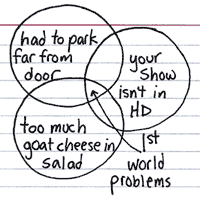
Call it a first world problem (and if you've missed out on this ironic way of talking about problems, just click on the link and get with the times!!), but I've found it oddly unsatisfying to be happy with my body. After a decade frustration, I now find myself wondering what all the fuss was about. Why in the world did I spend my entire teenage life and my early twenties consumed with this superficial quest?
knowyourmeme.com
In fact, I would absolutely call this weight obsession a first world problem. First world, as in it disproportionately impacts people who have time and energy (and often money) to put into attaining (or attempting to attain) a particular figure. People who have easy access to the media and feel pressured to look like the people they see in it. I know with absolute confidence that I'm not alone in my tendency to be consumed by body image issues. This problem has spread throughout first world countries (and beyond), sucking our time, our energy, and our happiness.

Let me be clear that I truly believe that taking care of our bodies is essential for living a good life. But where we go wrong is when we mistake slender figures as a sign of health. While being thin can absolutely be healthy for some, others must starve themselves (which is awfully unhealthy) to achieve these same standards.

We've forgotten that our bodies are all different. We've forgotten that diversity is a beautiful thing, that everyone looking the same, weighing the same, would be boring as hell.

And, as a result, we end up trying to attain this one precise figure, one that for a lot of people just isn't sustainable, life giving, or even fulfilling.

This attitude is absolutely everywhere I turn. Have you ever listened to people after they finish a big meal? What words come out of their mouths? "I shouldn't have eaten all that food." "Well, I'm going to have to go work that off." "Why did you make me eat all of that?" Or the even more unhealthy language, "I'm going to have to skip dinner for a week now."

We've been taught that our bodies don't look like they should and it leaves us feeling constantly guilty for enjoying food. Rather than focusing on how our bodies can be healthy so they work efficiently and effectively, we are overwhelmed with media images of the same thin figure over and over and over. We hear a constant chatter about weight all around us, we hear (thin) people talking about how fat they are, we see people judging others solely on the basis of their weight.

As Abercrombie showed us this month, we've been taught that to have a certain body type is to be happy, cool, to be popular, and to have it all.

But for those of us to whom a model's figure doesn't come naturally, how can we possibly have it all if we're not taking care of our bodies?

So I ask you: what is health? How do you know when you're healthy? How much effort have you put into attempting to achieve the perfect body? Do you struggle to find the balance between treating your body well and becoming consumed with food, exercise, etc.? 

I'd love to hear your thoughts.

Love,
Kelsey

Tuesday, April 16, 2013

Running: A Love/Story


This piece is going to take two, count them two, disclaimers.
Disclaimer 1: This story was written prior to, but edited after, the Boston Marathon explosions. The timing was a coincidence, but I decided to publish the story anyway, hoping that it doesn't communicate any sort of insensitivity, but rather the incredible sense of community people can develop by doing the same thing at the same time. My thoughts and prayers are with those affected by yesterday's events.
Disclaimer 2: Unlike most pieces written on Her/Story, this one lacks a thesis statement, a conclusion, and maybe even an argument. I've taken the name of our blog seriously and told a story, modeled off of a couple of storytelling venues that I adore: The Moth and Modern Love. Check them out!

I was 19 and a month into training for my first marathon when my grandfather, one of the best men I have ever known, died suddenly. I spent the next several months running in the midst of my confusion, trying to process my devastation, attempting to grasp what to me felt like true injustice. When my training ended, I completed the marathon, patted myself on the back, mentally checked "Marathon" off my bucket list, and stopped running.

Marathon Finish, Des Moines, IA 2008
Four years later, I would move back to Iowa to take care of my grandmother who had just been diagnosed with terminal cancer.

There's this saying in life that you should live like you could die tomorrow. It took Grandma and I an entire month to get over the grief and realize that Grandma needed to stop thinking she was going to slip off any moment. She needed to die like she was going to live tomorrow. And me? I needed to get out of the house more.

So Grandma and I started talking walks and I started training for another marathon.

It's been eight months and Grandma has officially outlived the time she was given by her doctor. And me? I'm still living in her house and I'm still running. I stay with her Sunday night through Friday afternoon, and other family members take care of her on the weekends. This means I get to spend my weekends visiting friends all over the Midwest.

Last weekend, I went to Kansas City to watch several friends run a half marathon. I was standing at mile 9, cheering like crazy for these random people that I didn't know, waiting for my friends to run by when I was absolutely struck by how amazing this whole thing was. Here was person after person running by me who had dedicated part of their life to doing exactly what I was dedicating part of my life to doing: running. Running a long freaking way.

Half Marathon Starting Line, Kansas City, MO 2013
There was a woman on the other side of the street cheering for the runners with her two kids, and I knew immediately she was a runner. There's this thing about runners that's just like with lesbians, they don't have to be running down the street or holding their girlfriends' hands (respectively), if you're one of them you tend to know who the other ones are.

So this lady and I are cheering loudly, and at some point the slower set of runners run by us and I'm watching them, yelling my guts out, and these people start looking at me, right in the eye, and saying "thank you." Thanking me. In the middle of their 13 mile runs. And I flash back to my 16 mile run the day before when I could have really used someone at mile 9 yelling for me, and I start yelling my guts out for these strangers, yelling because I get it, because I've literally been in their shoes, literally felt their blisters, literally wanted to quit just like they're looking like they want to quit right this very moment. And that's when the tears start flowing down my face, quite unexpectedly, and I'm surprised because, although I'm both a runner and a crier, they don't normally fit into the same section of my life.

But here's the truth about people like me who take at least 10 minutes to run a mile: we don't run long distance to beat the person running next to us. We don't run long distance for exercise either, because if we wanted to get that we'd just run 5ks. No, no, for people like us there's something much deeper at stake. There's something about identity, something about seeking ourselves going on. Maybe we're running from something, maybe we're running to something, or maybe we have something to prove. But the truth is you can't spend hour after hour hitting the pavement without having to confront yourself even if only just about, at bare minimum, how freaking tired your legs are. Maybe for these reasons, I have dated people who are runners almost exclusively over the years.

My very own cheering squad, Des Moines, IA 2008
I spend an hour cheering at mile 9 and then I move on. I head to the finish and I stand right next to the mile 13 marker, a tenth of a mile from the finish line. And I notice immediately that no one next to me is cheering. They're standing, watching quietly. And I make a quick decision to give the runners every bit of energy I can muster. Suddenly I'm screaming; I'm clapping so hard I have to take breaks because my arms get so tired. I'm saying things like "You're almost there." "The end is in sight!" "Power through!" But what I really want to be saying to these people is "Look! Do you see it? You accomplished your goal! You did the thing you wanted to do, the thing you spent hours training for, and even though you feel like total shit right now, you have conquered this run."

But the words won't come out of my mouth. They get stuck in my throat because by now I'm crying, full on crying, because I feel so proud of these perfect strangers. So I keep yelling the one-liners, praying they understand that I am mentally with them, one hundred and ten percent. And these people are looking up from the pavement at me, and I swear they are seeing my whole self. I swear they're seeing things in me I didn't even know existed. And a couple of them, even at the very end of this whole freaking race, tell me thank you as they run, sometimes stumbling, by.

My last friend finishes the race and still I can't pull myself away. These people have come too far, I keep telling myself, not to get cheered for in their last tenth of a mile. So I stand there, clapping, yelling, and crying, until I am totally exhausted (which is funny because I'm not even running). And finally I slowly walk away to meet my friends, the only three people at this race that I actually know. Leaving the race seems so strange though, because in this moment I'm feeling like I'm walking away from a crowd full of friends I've known my whole entire life.

Love Always,
Kelsey

Thursday, March 14, 2013

What’s in a Name?

Recently, a few articles have been written on the topic of women changing or not changing their last names upon marriage. I have long questioned the same system.

When I dated men, I always asked their opinion on the topic, partially because I knew I could never be with someone who expected me to take his name. But the truth is, even with the feminist spirit alive and well in this country, the majority of women still take their husbands’ names.

thenextweb.com
The obvious reason that women take men’s last names makes sense to me: if you want to share a last name with your partner, picking one name is logical. I’m not a big fan of hyphenating names because, as one of the above articles points out, it’s only good for one generation. If someone with a hyphenated name marries another person with a hyphenated name, what do they do?

In my experience, even couples who keep their own names upon marriage still give their children, if they have children, the husband’s last name.

At some point I realized that when a person signs a marriage license, she or he can declare whatever new name she or he chooses. Based on this information, I decided if I ever got married I would legally change my name to Pink Purple Crockpot, as a middle finger to the whole system (and also because it sounds awesome).

So when I began dating women, this line of thinking got more interesting. First, I decided Pink Purple Crockpot just couldn't work for me. Also, I no longer have the privilege of choosing whether or not I want to play into this name changing system. There is no room for two women – there’s no man’s name to take. Making decisions about this tradition became, for me, more than just a fun way to combat patriarchy; it became an actual problem that requires a sensible solution.

Call me a romantic, but I have a real desire to share a last name with my Hypothetical Future Partner.

blog.glamourdrops.com
For me, if my partner or I picked either of our names for both of us to share, the decision would feel symbolic of our relationship. If I took my Hypothetical Future Partner’s name, would it mean she has more power in our relationship? That she wears the pants? That she’s the man? That she won the coin flip? If she took mine, how would I feel about asking her to switch? And, given the hope that my Hypothetical Future Partner and I both have good relationships with our families, how could either of us decide to leave our family names for the others?

It’s interesting being a woman dating a woman, because we've both been socialized into the assumption that our last names would someday change. From a young age, it’s acceptable, even encouraged, for a girl to start doodling Mrs. Name-of-crush-here on her notebook. (And that’s to say nothing of a culture that asks women but not men to name their marital status simply by the title in front of their last names.)

So here I am, in a system that stems from a tradition that has no place for me and my woman loving ways, wondering what I’ll do with my name if I ever get married, knowing that even that simple thing – marriage – is a thing only some people and some states believe I deserve.

Who can blame the lezbos everywhere for keeping their own names, for not buying into any system that has marks of oppression all over it?

But I still want to share a name. I don’t want to make a new name out of nowhere. I don’t want to take and I don’t want to give, I want to share. So my solution is to fit my Hypothetical Future Partner’s name together with mine, just as we’ll attempt to fit our lives together (hypothetically of course). A little give and take. A little of her and a little of me. Compromise.

How does this work in the heterosexual world? Shit, I don’t know. But if people always chose the simple, easier road, we’d be in big trouble.

I understand that professionals that have careers prior to getting married would keep their names. And if you believe that your husband should be the head of your household, then yes, take his name. But otherwise, why not carefully consider the name you’ll (hopefully) be living with for the rest of your life, and be open to doing something nontraditional?

The same questions should be posed about how a proposal works, why only a woman wears an engagement ring, and why a man is told that he can kiss the bride at the end of a wedding (aren't they kissing each other?).

Just because I’m in a situation where I have to devise new strategies with my Hypothetical Future Partner, doesn't mean heterosexuals, particularly those who believe in equality of gender, can't or shouldn't question the systems in which they are included.

If a name is so unimportant, why not give it up for a new one?

Or, as I've argued, if a name is so important that it tells others about who you are – and who you and your partner are together – then why not choose it wisely?

What do you think?

Love,
Kelsey

Wednesday, February 6, 2013

Flirting with Men: The Lesbian Loophole

When I was younger, I dated a lot of guys. In high school I tended toward a "3 month rule," ending most relationships before they had time to get remotely serious. In college I had longer, more fulfilling relationships with guys, but they, like the others, all eventually dissolved.

I came out at the end of college and stopped dating men. I do, however, still tend to flirt with them.

Why does this still happen?

Is it my naturally flirtatious personality? My love of attention? My enjoyment of all very personal, intensely private, and intimate details of other people's lives? An urge to fit into a heternormative lifestyle? Repression of my full lesbian identity?

I honestly don't know. It's likely a combination of all of these, or at least most of them. (Flirting is also a multifaceted term that I'll dissect a little bit later.)

More interesting are the reasons why I haven't given this habit up.

I have this theory that most (and I repeat, most. I'm making generalizations here, people) heterosexual men don't learn how to converse about feelings and emotions until they date their first serious girlfriend. I don't think our society encourages men to express most of their feelings, especially not with each other.

What I get the opportunity to do then, is talk about feelings and emotions with men on a platonic level. Being a lesbian removes me from having an agenda. I have no intention of dating the guy, I'm not looking for a one night stand, in fact, I've completely taken both romance and sex off the table. I'm not threatening to other women and I don't have ulterior motives.

In fact, I would argue that my relationships with men have gotten immensely better since I came out. Gone is that question of if there's something bigger going on between us. Gone are the awkward "are we on the same page" questions. I drop the "I have a girlfriend" line in the first five minutes of our conversation and all of a sudden I have simplified the equation. (This isn't to say that every guy I talk to is into me and that playing the Lesbian Card lets them down easy. This also eliminates their concern that I'm into them when they aren't into me.)

Awhile back, Madie wrote a blog about a court case in Iowa. In short, a man fired a woman for being too attractive, which for him equated to being too seductive. In order, he said, to continue being faithful to his wife, he had to end his professional relationship as a boss to an attractive woman, even though she maintains that she had no interest in him romantically. In essence, he didn't believe he could keep it in his pants with her around, despite her disinterest.

This case demonstrates a deep seeded belief in America that women and men can't be friends, especially if there's any attraction between them. There's too much chemistry, too much seduction, too many SEX THOUGHTS, the theory goes, for men and women to be in platonic relationship with one another.

This is such a detrimental line of thinking. I'm not trying to argue that all women and all men have to be friends, in fact I think there are some decent reasons some men and women are not always friends. But folks: we have so much to learn from each other. Listen, I might be a lesbian, but I have no idea what it's like to be a man. I don't even date them!

When I titled this blog, I used the word "flirting." I've always used the term to label my behavior when I'm asking men about their lives. A more fitting description? Confidently asking personal questions and sticking around to hear the answers. But I've always called it flirting because it seems so ingrained in our culture that men and women can't or wouldn't have a serious conversation about their personal lives without sexual chemistry.

Being a lesbian is a strange but real loophole in the old women-and-men-can't-be-friends way of thinking. Because I don't date men there is a removal of the possibility, the removal of an agenda. So I've managed to avoid the problem myself, but most men and women continue to face this challenge.


I don't get it - because when women (ok, women in my life anyway) hang out, most of what they do is talk about their feelings, their relationships, their ideas about life, etc. I do this with other women constantly, straight and queer alike, without having awkward confusion about if we're into each other. Why wouldn't women and men be able to converse together about these same things without these problems?

All of us, straight or queer, even those of us in relationships, interact often with people we find attractive. That's right, I said it: we - single and committed - are all wandering around the earth feeling attracted to people who aren't our significant others. And you know what those of us who are in monogamous relationships do about it? Well, hopefully, ABSOLUTELY NOTHING.

I know we all like to think that once we fall in love we stop being attracted to everyone else on the planet, but in my experience that's just not true. What's also not true is that if we are attracted to people we must follow our urges. In short, we can be attracted to people we choose not to be with.

There's a problem if we have to fire our employee simply because we're attracted to her or him. There's a problem if men and women can't be friends because they can't handle themselves to have a platonic relationship with someone to whom they may or may not be attracted.

As stated previously, I've mostly avoided this problem, what with my woman-loving and all. But my argument is that rather than denying and ignoring and even avoiding people to whom we feel attracted and possibly missing out on some fantastic friendships, we should learn how to manage sexual attraction in a way that allows us to be both a great friend and faithful to our partner. Self-control, rather than missing out on great friendships, is the key.

I'd love to hear your thoughts.

Love Always,
Kelsey

Wednesday, January 2, 2013

A Letter to My Teenage Self


On a recent road trip across the Midwest, my girlfriend read to me from the book The Letter Q, edited by Sarah Moon. The book is a compilation of letters written by famous queer authors to their teenage selves. It will make you laugh, it will make you cry, it will make you angry and happy and, if you're queer, it'll make you proud.

The book inspired me to write to my teenage self. Although most of these authors are middle aged now and have decades more time and distance from their teenage selves than I do, I decided to write a letter to my 12 year old self as well. I share it with you now, in hopes that you, too, will reflect on the lessons you've learned, the wisdom you've gained, and the experiences you've had - significant or seemingly insignificant - since your years as a teenager.

Dear Kelsey,
You are on the brink of your 13th birthday. This birthday will mark not only your first year as a teenager, but also your first kiss (or at least that's what you'll lead everyone to believe). You're changing, and you know it. I see you trying desperately to fit in with your peers, trying to be someone you're not. But Kelsey, you've always been different.

You don't care about what you wear or about what your hair looks like or about wearing makeup. News flash: your 23 year old self doesn't either. And that's ok. But while we're on the topic, don't wear lipstick to school on that random October day next year because it'll get on your teeth and no one will tell you all day.

I know your body is changing and you aren't sure what to do about it, but I beg you to try to love yourself the way you are. In a couple of years, you'll succumb to pressure and begin to slowly starve yourself. Kelsey, don't do it. I know it's hard to believe now, but you're a beautiful young woman and not eating enough will not solve any of your problems. You eventually learn that, although we still have the occasional battle today.

Another word of caution, my friend. I know, as you know now when you search down deep and listen to that voice inside of you, that your trend of dating guys for short stints has more to do with your insecurities and desire to be accepted than with the hope of any lasting romantic relationships.

When you come out (oh yeah, you're a lesbian...surprise!), you'll promise yourself that you'll never lie to yourself again. Years of repression of your true self will teach you that telling yourself the truth is always, without a doubt, universally better than lying to yourself. Even if it means you still lie to everyone around you (although mostly you'll choose to tell everyone else the truth too). This will change the way you live your life, and it will allow you to love yourself a little bit more.

I have good news from the future, my dear. After years of knowing your life is lacking something, you will go to college and learn how to talk to people about stuff that matters. You will begin to ask other people questions, you will discover a thirst for understanding others in a new way, an exciting way. You also begin to enjoy your family, looking forward to the time you get to spend with them.

As for the faith life that is only right now, right this moment, beginning to form, I will leave that as a question for your future. All I will tell you is that I needn't assist you in this journey, as you will only dive deeper and grow more intrigued with God and faith over time. It will be an adventure, one that I will promise you will be completely worth it, even as it will seem impossible, confusing, and frustrating for many years.

I have to warn you that your first heartbreak will be harder than you can imagine, but you will survive. You will find comfort in the arms of many friends, new and old, and they will hold you up and love you like crazy and you will never be able to repay them (and better yet, they won't expect you to). You will realize who you can count on in the midst of this incredibly painful time, and you will grow new appreciation for the wonderful people in your life. Through all of your pain, in every season, hold on to the hope that good things really can grow from bad, that time and distance really do help heal you, and that you are loved, even when you don't feel that you deserve it. And don't worry, you will love again.

Sometimes you will get very stressed about life and the future, and my advice is to spend time with the people who make you laugh and let you talk about it when you want to.

With love from your future self,
Kelsey

 P.S. You do learn to stop feeling Catholic guilt, but you never learn to sing in the right key (although it won't stop you from singing).

Tuesday, November 20, 2012

The L Word

Views expressed in this blog are solely the author's experience and opinions. They are not intended to speak for other or all queer-identified people.

Two years ago, almost to the day, I came to the beautiful conclusion that I am attracted to women. It was a moment alive with emotion and enlightenment - the dawn of a new day.

Hey, I took this picture!
Others might call it a panic attack (which may or may not have involved my head over my toilet, gasping for air).

It's been quite the journey, and those who know me know that I've changed along the way. I've also changed the language I use to identity myself.

I came out to my parents using not very eloquent language, essentially spitting out that I was "s-s-something other than s-s-straight...even though I might never date a woman."

A couple of years later I comfortably use the term lesbian. Somewhere along the line I claimed words like "bisexual" and "queer" to try to put a name to my...condition.

The summer before I came out, I expressed to my best friend that "uhh...if sexuality really is a spectrum, maybe I'm somewhere on it...?"

Her response? "Well, Kelsey, I guess I am too. I mean, I'm attracted to Angelina Jolie."

people.com
The point is that in two years I went from "so maybe I don't just like boys" to easily taking the "lesbian" descriptor.

Why is this?

There are a couple of reasons. First of all, as I will explain to anyone who asks, I've grown comfortable with the thought that chances are that I'll settle down with a woman, not a man. I can't guarantee that I will never date a man again, but listen folks. I dated 13 of them before I turned 22. I tried really hard to be straight. 

The more complicated reason that I've taken the fetching "L Word" title is that it's just freaking easier than trying to explain that I may or may not be somewhere on an imaginary spectrum.

I have a friend who identifies as bisexual, but lesbians always assume she's one of "the gays" and straight people always assume she sticks to dating men.

And the truth is, if you lined up every person in this planet, I would probably pick out many more women than men that I find attractive. But to be fair, I haven't seen every person in the world, so I can't say for sure.

But, if you read between the lines here, what I'm admitting is that I am sometimes attracted to men. (Collective gasp.)

Story time! When my girlfriend was first coming out (before we were dating), she said to me one day, "But Kelsey! What if I come out to all of my family and then I end up marrying a man?" And I said to her, "Lisa, are you attracted to me?" To which the obvious response is "yes." And I said, "Then stop worrying about it."

But it's a legit fear, folks. I've spent the last two years coming out to people. That's a lot of time and effort.

I got drinks with a friend a few weeks ago, and we were talking about my lesbian-ship. (Yeah, that's a word.) And I explained this convoluted I-think-I'll-probably-be-with-a-woman-but-I-can't-guarantee-it business and that's when he said it. "You're not even a real lesbian!"

Well shit.

Is that true?

I'm not going to lie to you friends, I'm attracted to the sexiest man alive (which those closest to me either love or hate about me). I'm attracted to some men, sometimes. It happens occasionally.

So here I was, in the midst of another identity crisis - but I was much more mature about it this time, because this time I had a support system. So I talked to every queer identified person in the world and asked them what they thought. (What? You don't believe me? We have a listserv. There's a club. We talk.) And as I was waiting for all of their responses, I came to my own conclusion.

It's my own freaking identity! If I feel like lesbian is the word that fits me best, then I'm going to own it, damn it!

But it has left me with some questions. Why is it so freaking hard to be somewhere on the middle of a spectrum - whether homosexual or heterosexual, female or male, Democrat or Republican? What's with the black and white? What's with the one word answers to open ended questions?

Back in the day when I was in college, I remember reading an article about a woman who identified as a lesbian and married a man. She continued to identify as a lesbian even after the wedding. At the time, I was puzzled by this, but recently I've come to realize the importance of having an identity to which to cling, regardless of who you marry.

But what’s so wrong with calling yourself bisexual? Unfairly, maybe it’s because of the stigma bisexual identified people have to deal with. Maybe it’s because they are seen as indecisive or promiscuous. Maybe it's because there are assumptions on the part of some queer people and straight people alike that bisexuality doesn't exist. Or maybe, in this woman's case, she just felt her identity was a lesbian.

I’d like to say I live under the title of lesbian because it fits me perfectly, but I don’t think that’s true. I've chosen it because it is probably the word with which I most closely identify, but also because it gives me a group - a community I adore - to belong to. And maybe because it’s easier than other options, easier than the gray, somewhere-on-the-spectrum explanation.

I'd love to hear your thoughts.

With love,
Kelsey

Friday, October 19, 2012

"Women's" Issues


From Amherst's terrible dealings with a rape (or many rapes) on their campus to the grotesque statement that "some girls rape easy" to the "Top 10 Ways to Get Away with Rape" flier found in a men's bathroom of Miami University, it's been a rough week in the news.

With the election right around the corner, we're hearing accusations on both sides of the aisle about how each candidate handles "women's" issues.

Interesting, politicians. What exactly is a women's issue?

Is it abortion and birth control? Whether or not Planned Parenthood will continue to be funded by government money? How many women have jobs right now? Something about single parents and guns?

I don't know about you, but I'm awfully sick of hearing about the "women's vote," as if all women will be voting the same way in this election.

Why are politicians only targeting female voters now? Why in the world haven't they been trying to win everyone's votes for their whole campaigns? And why is it assumed, by politicians and by the media, that only women care about so-called "women's" issues. That only women will be swayed one way or the other by how a politician will handle policies concerning women?

These issues - from rape to birth control - are issues that concern all of us. Just because you don't take birth control doesn't mean you shouldn't be concerned about it's access for those who want to use it. Just because you may be at a much lower risk of being raped simply because you are a man doesn't mean you shouldn't be concerned about those who are.

We should be outraged at the attitude about rape in this country. All of us should be outraged. This isn't an issue only for those who have been raped, only for those who fear rape, only for those who are statistically more likely to be raped. The minute you minimize this to a "women's" issue is the minute you dismiss it as something men don't have to care about. 

I don't think all men are rapists. That isn't what I'm saying at all. I'm saying most men aren't rapists. I sincerely believe that most men think sexual assault is a horrific act. But when we hear men - men who are elected officials- say shit like "some girls rape easy," we know that all is not right in this country.

When we find a flier called "Top Ten Ways to Get Away with Rape" in a men's bathroom we know something is wrong.

These aren't just "women's" issues. Just because the population most at risk of being raped is women, doesn't mean men should turn off the news when the topic comes up. When the media casts these huge issues as only women's concern, they do this country a great disservice. These are issues that affect everyone in the United States (and beyond). These problems need to stop being labeled in such a way that makes people believe only women have to be concerned.

We should all be concerned.

Not just because we all have mothers and sisters, but because we're all human, damn it.

Why isn't anyone on the news curious how men are voting on so-called "women's" issues? Have they forgotten men will be voting in this election, too? On the very same issues women will be voting on?

Or is it because politicians spent their entire campaigns worrying about men's votes, so they have to spend the last couple of weeks on "everyone else?"

The media is essentially telling men to close their ears when something concerns women comes up. This attitude on "women's" issues is how we end up with bullshit like "legitimate rape." We need everyone to be informed - especially people who are making decisions about this countries' policies.

These are issues concerning women that we should all have thoughts about. This doesn't mean we control women, or tell them how to think or how to act. It means we all get informed on issues that affect those around us. Try talking to the people who are affected by the issue at hand. 

Love,
Kelsey

P.S. Consent is sexy, and so is communication.

Wednesday, September 12, 2012

Queer/Story: Stereotypes & Life Lessons


(Names in this blog post may or may not have been changed. Also, for purposes of this blog, “queer” refers to the naming of a person who does not identify as heterosexual. It caters to the belief that sexual orientation is a spectrum, encompassing lesbian and bisexual people.)

I have a system of categorizing women, based on lots of stereotypes and a little life experience.

There are three categories, upon first view of a woman, that I place her into:
1. This woman is definitely straight:


2. This woman is definitely queer:

3. These women may or may not be queer:

(Photos have been used with permission and were taken from subject's own profile pictures.)

The system has proven very effective, but, to be fair, here are a few examples of my failures:

When I moved to Minneapolis last August, I met a whole new group of people. Up until this point, I would have likely said that stereotyping of any kind was WRONG and we SHOULDN'T DO IT. EVER. But I was single and living in one of the gayest cities in the U.S....what's a girl to do?

Then I met a woman, let's call her Emily. Emily worked for an LGBT organization. She spoke queer language (yes, we have our own language). She dressed in flannel and plaid. My gay-dar went off every time we talked.

Come to find out, Emily is straighter than an arrow. The girl likes men. If Emily was a lesbian, she would certainly be taking the title. But seriously folks. She is into dudes. In fact, Emily often has to come out to people as straight, because she fits so well into lesbian stereotypes. After many conversations about this topic, we named her a cultural lesbian.

Next is a story about two good friends of mine. One, Anna, identifies as heterosexual, and the other, Jamie, identifies as a lesbian. I went through a phase last year in which I teased Jamie about all of the categories she fits into that are stereotypical of lesbians. One day, my example was her tie-dye t-shirt. It was my assertion that that tie-dye made her look gay. She argued that her t-shirt in no way identified her orientation. Anna jumped in, asking if she put on the tie-dye t-shirt if she would look gay. So they switched shirts to prove a point.

Jamie was wearing Anna's form fitting green sweater (and looking mighty uncomfortable, I might add). Anna had on Jamie’s t-shirt. And let me be clear - Anna looked as straight as ever.

So it wasn't the tie-dye.

And at some point I began to reconsider the stereotyping I had become accustomed to. Maybe people didn't need to be categorized. Maybe I don't need to make assumptions about other people's orientations.

Enter Sarah, my dear bisexual friend who just started grad school. She told me about a girl in her class who made a comment about the rainbow sticker on Sarah's water bottle. (Indicator number one.) I asked a few questions. Does she have short hair? What kind of clothes does she wear? But the next piece of information I got was even better. THIS GIRL PLAYS RUGBY. Folks, rugby and softball are lesbian gold mines. Game, set, and match. (Ok, I realize that's a tennis expression, but just go with it.)

"Sarah!" I exclaimed. "This girl has got to be queer. She. Plays. Rugby. And loves LGBT stuff!" Sarah was a little more skeptical. But then the girl asked Sarah out to drinks. Done and done. And over the course of the night, this girl shared with Sarah her love of women. And I patted myself on the back for being so wise, without ever meeting this girl, I might add.

Final story. Literally 10 minutes after coming out as queer to my then-self-identified-straight-friend Lisa, she pulled a wallet out of her back pocket. "Lisa!" I exclaimed. "You know that's super stereotypical lesbian of you, right?" Her face reddened and she stammered out something about not knowing that.

We were dating three months later.

If I work to present myself as female, why can’t I work to present myself as lesbian? I don’t believe dresses and heals are embedded in my mind as things I need to wear simply because I have a vagina. There’s a heck of a lot of socialization that goes into the way I was taught to dress – and act – simply because I was born with female parts.

So why would it be problematic to also consider that some people present as queer? That it may not be because I have flannel on, but because I consciously chose to have flannel on, that identifies me. Unless you live in north country, because people, please. It's cold up there and people need to stay warm somehow.

To be fair, I don’t fit a lot of lesbian stereotypes. I like my long hair. I wear dresses, the occasional pair of heals, and I sometimes even shave my legs. But then again, I’m in a softball league, I own a lot of flannel, and my favorite outfit is a t-shirt and jeans. Just as I do with my femininity, I also make some decisions about how queer I do or do not look. (Ok, and a lot of it is based on me being particularly lazy when it comes to my presentation.)

I was in a conversation with a friend of mine last week. The friend, who identifies as heterosexual, was laughing about a time when she was rocking a “lesbian outfit” and someone made a comment about her looking like a lesbian.

“Oh my gosh, right?” I teased. “It’s so frustrating when people assume I’m straight.”

So you tell me. Stereotyping in the queer world: good or bad? Is there such thing as looking straight or looking queer? Am I correct in my categorization of my fellow bloggers?

Wednesday, August 8, 2012

(Almost) Drowning: Reflections on one bad decision

I almost died last week.

I was visiting my girlfriend, Lisa, in Michigan and she, her best friend Bea, our good friend Jeremy, and I decided to jump off Blackrocks into Lake Superior. The area was quiet water, tucked in a completely clear water cove. Lisa, Jeremy, and I had already done it a few days prior, much to my hesitance, but we lived through it, so we decided to take Bea.

It started like many traumatic events do. Bea described the day as jovial - we were laughing and joking, soaking up the sun, enjoying the day. They even convinced me to dive off the rocks.

There were three ways to get out of the water once you were in it: wuss out and walk to the beach, climb the rocks back up, or swim around the side of the peninsula and walk up some big rocks (see picture) to get back to the starting point. We chose the third option when we had jumped the other day, but because of the waves we had been climbing the rock on this day.

But Bea is an adventurer, the kind who pushes people out of their comfort zone sometimes. She's in ROTC, placed 10th in track nationals in two events (one of them was a marathon), and although she's probably only 90 pounds the girls is quite strong.

Bea wanted to swim around the peninsula. She went by herself a couple of times to try it, but got freaked out and came back. On Lisa and I's last jump, Bea convinced us to swim with her. Jeremy's ears were full of water and he decided to stay put.

As we were swimming around the peninsula, Lisa at one point exclaimed, "Look how big these waves are! There are waves in these waves!" We should have taken it as a warning sign, but instead we forged ahead. I was in front and because I'm cautious by nature, every few seconds I turned around to yell at the other two to hurry up. I got to the rocks, timed the wave right, and walked up to the top of it.

"She's walking on water!" Lisa said, much to Bea's delight.

Next, it was Lisa's turn. She got up on the rock just fine, but within seconds a wave came and pushed her back off.

I should stop and explain what was behind the rock we were getting up on: huge, massive rocks. Rocks that we couldn't climb up on. Rocks that we didn't want to hit.

As Lisa slipped off the rock, she looked up at me and I saw in her eyes an expression I had never see before and hope to never see again: terror. That was the moment we knew we were in trouble.

She managed to get back up on the rock and told me repeatedly that she was fine. As we turned our attention to Bea, we became more worried. Bea never even made it close to climbing up the rock we were standing on. As a wave carried her past the rock, Lisa bent down and grabbed her hand, most likely literally saving Bea's life. Bea was in a panic, not able to move at all, and Lisa held her through probably three or four waves until Bea slipped out of her grip. The next wave that came pushed Lisa and I both back into the water. It sent Lisa straight for a rock, which her head just narrowly missed.

I grabbed Bea, worried that her panic would inhibit her ability to swim. Bea had, at some point, began yelling for help, but the waves crashing on the rocks covered her cries. I held Bea for a moment, until we both realized that we wouldn't be able to swim back to the rock if we were clinging to each other. As we let go, we looked up to see the Lisa had gotten back on the rock and was safe. The waves had calmed. Relieved, we both swam back to the rock and climbed up, finally safe.

Jeremy had noticed our absence and had come looking for us after we didn't return. He saw the second half of our misadventure, and was about to jump in just as we rescued ourselves. None of us have much memory of the last bit of almost drowning, but together we pieced together the story.

Two seconds into safety, Lisa started laughing. Hysterically. I looked up at her, confused, until I realized that everyone handles trauma differently, and Lisa was a laugh-er. Eventually we all dissolved into giggles and took a few pictures to document the experience.

Now I'm not a very controversial person. I don't typically get in the middle of debates, as I don't like to argue. (I'm gay though, right? So sometimes controversy happens accidentally.) But I have some potentially controversial theological things to say about this situation.

Just as I don't believe God made those huge waves almost kill us, I also don't believe God calmed them. I don't believe God makes a habit of controlling the elements. I don't think God sends hurricanes or tornadoes, nor do I believe God saves some people from them sometimes when God doesn't think it's their time to die, while leaving others to die because it is "their time."

This isn't to say I don't believe God wasn't present the day we almost drowned. I absolutely believe God was there, helping us remain calm. I don't believe God calmed the waves; instead, I believe God calmed us. Lisa describes almost hitting her head on the rock as completely peaceful. Bea, after a few very tense moments, calmed down completely and swam herself to safety.

We all left Blackrocks that day knowing that people die doing what we did. All those newspaper articles I've read about drownings suddenly make sense. I don't believe the people who have died in those events died because God decided it was their time. I don't subscribe to "everything happens for a reason" theology. Instead, I believe God desires life. I believe God desires us to live fully - all of us - for a long time.

I also believe we can let God help us. I don't believe God ordains bad, but that God can help us to live better, help us to stay calm, and help us through waves.

I don't believe that God chose to save me because "it's not my time to die yet." I have a hard time believing it's ever anyone's time to die. But I will say that living through that experience helps put the shortness and frailty of life into perspective. We are not as strong as we sometimes like to believe. We are not stronger than some of life's waves, physical and otherwise. What we can do is remain calm, level headed, and try to keep swimming.

What are your waves in life? Misadventures? How do you make sense of them?

Warmly, Kelsey

LinkWithin

Related Posts Plugin for WordPress, Blogger...